We’re a Joomla-focused SEO team. We do the work Joomla’s editor can’t automate — Itemid deduplication, SEF URL configuration, extension crawl-surface auditing, Schema.org plugin architecture, multilingual association repair, and AI search readiness. Free audit. Transparent pricing. No lock-in contracts.
If your current SEO team is treating your Joomla site like a WordPress site, they’re missing the problems that are actually costing you traffic. On WordPress, one page means one URL. On Joomla, a single article can generate four different indexable URLs depending on which menu item routes the visitor to it — each with different metadata, different canonical tags, and different Itemid values. All indexable by default. All splitting your ranking authority.
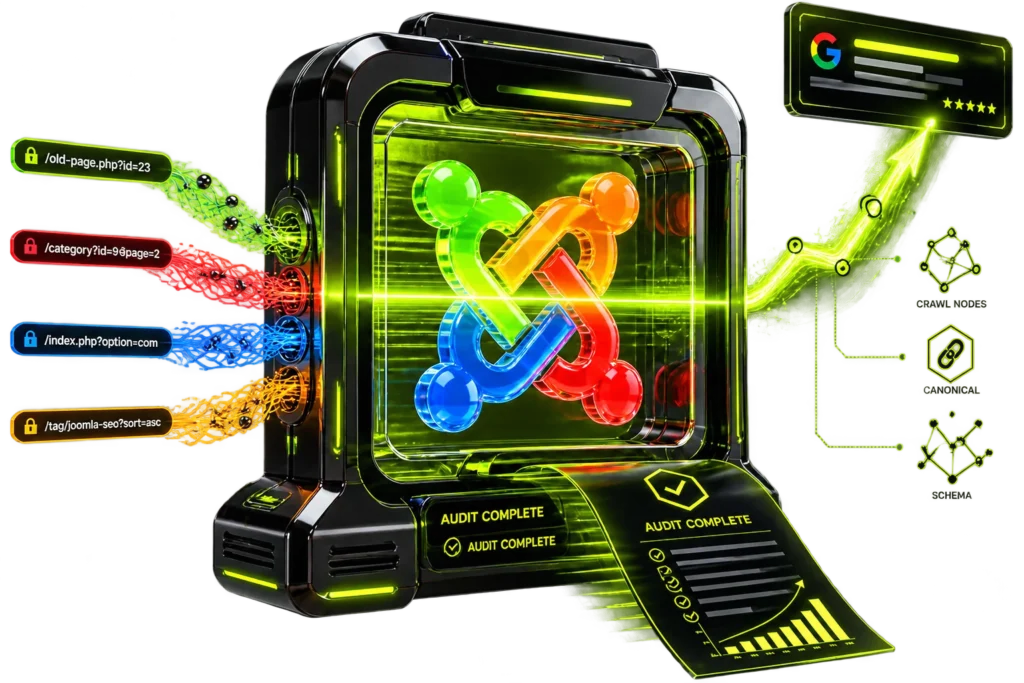
Every URL on a Joomla frontend contains a hidden parameter called Itemid that tells Joomla which menu item controls the routing. Change the menu item, change the URL — even if the content is identical.
This is what we check first on every Joomla audit — and what we find broken on almost every site we’ve touched. We trace every article through every possible menu route, identify every duplicate Itemid URL Google has indexed, and consolidate them to one canonical path. The ranking authority that was split across four URLs starts compounding on one.
Itemid=101 → /about-us
Itemid=205 → /company/about-us
Itemid=101 fallback → /component/content/article/1-about-us
Itemid=87 → /who-we-are
Every extension on your Joomla site can create its own indexable URL structure. VirtueMart generates category, product, filter, and pagination URLs. JEvents generates date-parameter URLs for every calendar view. K2 creates its own routing hierarchy. Community Builder produces a member profile per registered user. A typical Joomla site with three active extensions can have 3–10× more indexable URLs than actual content pages.
Your template’s overrides control what HTML your site actually renders — heading tags, schema output, meta positioning, structured data emission. An override written for Joomla 3 that survived through 4 and 5 can be silently breaking your heading hierarchy, canonical tags, or Schema.org markup on Joomla 6 without anyone noticing.
Your Joomla site has five different places where metadata can be set: Global Configuration, Menu Item, Article, Category, and Extension. When they conflict — which they do constantly — Joomla resolves in a specific priority order that most site owners have never read. Meta descriptions render blank. Titles change based on which menu item routed the user.
If your site is on Joomla 5 or 6, you have access to native Schema.org support through the System – Schema.org plugin — but most sites either don’t have it enabled, have it misconfigured, or have it conflicting with template-level schema. Joomla 4 sites used the deprecated Microdata format, and many still have broken Microdata leftover from Joomla 3/4 overrides.
If you’re running a multilingual Joomla site, your content depends on “Associations” between translated articles, categories, and menu items. Change an alias without updating the association, and hreflang points to a 404. Restructure a category tree, and half your Spanish site loses its English partners. Google serves the wrong language to the wrong country and you lose international traffic silently.
Results reflect a real engagement over approximately eight months. The numbers are accurate for this project. We don’t guarantee the same outcomes elsewhere — search depends on your market, competition, content, and starting point. What we guarantee is the methodology.
This is not a promise. It’s a scope. Everything below is what we actually do on a Joomla SEO engagement — organized by what it accomplishes, named specifically enough that you can verify each item after we’ve done it. Nothing here is subcontracted. Nothing is delivered by “our partners.” Nothing is aspirational.
The foundation. Nothing else on this page produces results if the technical layer is broken.
Using the same methodology Googlebot and AI crawlers use — we audit what your Joomla site actually sends, not what the admin panel says it should send
Across every menu, every alias, every legacy route — every article traced through every possible URL and consolidated to one canonical route
In Joomla Global Configuration and the System – SEF plugin — search-engine-friendly URLs, URL rewriting via .htaccess, "Remove IDs from URLs", "Enforce a suffix by redirect" (Joomla 5.2+), and "Strict Routing" where appropriate
Across every route variant — resolving conflicts between Joomla core, 4SEO, EFSEO, JoomSEF, and template-level emitters
Using Joomla's core Redirect component or ReDJ — 301 chains eliminated, loops broken, orphaned redirects cleaned
Using JLSitemap or XMap — component-aware, extension-aware, with proper inclusion/exclusion rules per content type
Written to match your actual crawl strategy, not the shipped defaults
Parameter URLs blocked, thin extension-generated pages noindexed, orphaned media pruned
Template asset optimization, module load impact, cache configuration (System Cache, Conservative Cache, Page Cache) tuned to actual site behavior
Template overrides and third-party extensions frequently break what Joomla's responsive themes get right
And security header configuration
Indexing errors, crawl anomalies, mobile usability, Core Web Vitals reports
Where access is available — actual Googlebot behavior, not simulated
Joomla’s metadata hierarchy is where most on-page SEO goes wrong. This is where we straighten it out.
Mapping and resolving conflicts across Joomla's five metadata sources: Global Configuration, Menu Item, Article, Category, and Extension
At the level where it actually renders, not just at the article level
Across every indexable page — fallback chains configured so blank descriptions don't ship silently
Against rendered HTML, not admin fields — templates and page builders regularly break H1–H6 structure without warning
Covering existing articles, categories, tags, and extension-generated content
20+ target keywords for Basic, 40+ for Standard, unlimited for Custom
Using Joomla's actual content architecture — articles for informational, category pages for hub content, tags where topically meaningful
Using Joomla's Article/Content Link and menu structure to create deliberate topical clusters
Alt text, compression, lazy loading, responsive sizing, WebP conversion where supported
3 pieces/month on Basic, 6 pieces/month on Standard, unlimited on Custom
Since Joomla 5, the platform ships with native Schema.org support through the System – Schema.org plugin. Most sites either don’t have it enabled, have it misconfigured, or have it conflicting with template-level or extension-level schema emitters. We fix all three.
On Joomla 5 and 6 — Organization or Person base type, social profile URLs, contact information
Article, BlogPosting, Book, Event, JobPosting, Organization, Person, Recipe (Joomla 5.x+)
For types the native plugins don't cover — LocalBusiness, Product, FAQ, HowTo
Where native isn't enough — Tassos Structured Data Pro, TF Structured Data, Google Structured Data
Against rendered HTML for every schema type — not admin configuration, actual output
Joomla sites commonly have schema from template, SEO extension, and page builder all emitting simultaneously, producing invalid or duplicate JSON-LD
On Joomla 3/4 sites migrating to 5/6 — removing legacy Microdata from template overrides so JSON-LD can render cleanly
Every active extension on your Joomla site is a potential SEO risk or opportunity. Nobody except a Joomla specialist knows how to audit them properly.
Every enabled component, module, and plugin catalogued with its SEO impact
4SEO (the successor to sh404SEF, discontinued August 2023), EFSEO, JoomSEF, or native Joomla SEO settings depending on what's best for your site
For VirtueMart, HikaShop, and J2Store — product URL structures, category pagination, filter surfaces, checkout flow indexation control
For JEvents and DPCalendar — date-parameter URL control, Event schema emission, past-event archive strategy
Community Builder, EasyProfile, and directory components that generate member/listing pages needing indexation decisions
Two SEO extensions emitting different canonicals, template + plugin double-emitting schema, sitemap extensions not respecting SEF configuration
sh404SEF (discontinued), abandoned components, extensions incompatible with your Joomla version
Content and technical work drive rankings only if you have the domain authority to compete. This is how we build it — editorially, without shortcuts.
Using Ahrefs and Semrush — referring domains, authority distribution, toxic link identification
Where genuinely toxic links exist (rarely — Google is better at ignoring them than most agencies claim)
Sites linking to your Joomla-CMS competitors that aren't linking to you
5/month on Basic, 12/month on Standard, unlimited on Custom, all from sites with real editorial standards
On Standard and Custom plans — story angles pitched to journalists and industry publications
Reclaiming brand mentions, earning inclusion on genuinely relevant resource pages
Finding sites that linked to competitors' now-broken URLs, pitching your page as replacement
Where your buyers are searching locally, we compete locally. Our local SEO work on Joomla starts with a proper Google Business Profile — categories, services, attributes, business hours, and service areas configured against what your buyers actually search for. NAP consistency gets enforced across your Joomla site, your GBP, and every major citation source we can find you on. Local schema goes in via Joomla’s native Schema.org System plugin using the Custom schema type for LocalBusiness — the individual native schema plugins don’t cover this one yet, so we build it as JSON-LD directly. We handle citation building and audit across major aggregators plus industry-specific directories your buyers actually use, build a local keyword strategy around location-modified queries and “near me” patterns, and set up a review generation process for Google, industry review sites, and Trustpilot where relevant.
Joomla’s native multilingual system is one of the most powerful in any CMS — and one of the easiest to break.
Every translation pair validated, orphaned translations identified, association-broken pages flagged
One menu per language, proper alias structure, language filter properly configured
And validation against rendered HTML, not admin configuration
Process for updating translated aliases without breaking Multilingual Associations
Language-specific sitemaps, hreflang self-reference verification
In Google Search Console per language variant
Controlling what Joomla serves when a translation doesn't exist
Migrations lose rankings. Bad migrations lose them permanently. This is how we protect yours.
Content model mapping, extension replacement, template rebuild, URL preservation, database migration plus manual cleanup
Using Joomla's built-in upgrade path with SEO validation at every step (template overrides break, Microdata needs replacement, extension compatibility varies)
The Backward Compatibility 6 plugin (shipped with 5.4) makes this the smoothest upgrade in Joomla's history; SEO validation still required
Every indexable URL catalogued before we touch anything
Every old URL mapped to its exact new equivalent, never bulk-redirected to homepage
Captured pre-migration; every meta title, description, canonical, and schema output validated against baseline post-migration
Search Console, server logs, rankings, traffic
If regressions appear, we know exactly what caused what and how to repair
AI engines — ChatGPT, Perplexity, Google AI Overviews, Gemini, Copilot — cite only a handful of sources per answer. Joomla has real structural advantages here that most site owners aren’t leveraging, and getting cited in generative answers is now a distinct visibility channel from ranking in blue links.
We start by verifying server-side rendering — Joomla renders SSR by default unlike JavaScript-heavy platforms, which means AI crawlers can actually read your content. Then we optimize the native Schema.org System plugin (Joomla 5+) for AI extractability specifically: the JSON-LD it produces is exactly what LLMs use to understand entity relationships, so getting it complete and unambiguous matters more than getting it minimally valid. Entity consistency is next — the organization name, person names, product names, and locations rendered identically across every content type, so LLMs treat them as the same entity rather than fragmenting them.
The content-side work: structuring your paragraphs in extractable question-answer patterns, writing answer-ready content blocks in the format Google AI Overviews and Perplexity actually cite, implementing FAQ schema across relevant pages for direct AI Overview capture, and validating the structured data for LLM consumption — which goes beyond Rich Results Test to checking that the JSON-LD is unambiguous enough for AI parsing.
We report so you can verify the work, not so we can bill for reports. Every month you get a plain-language SEO report — what we did, what changed, what to watch, and what’s next — with keyword ranking movements tracked against your target set and traffic and conversion changes in GA4 explained rather than just charted. Crawl health monitoring covers indexed URL trends, Google Search Console coverage errors, and sitemap status. On Standard and Custom plans you get a monthly strategy call with your SEO lead and a quarterly roadmap review where we look back at what worked, forward at what’s next, and adjust based on the data. Real-time access via Slack or email between reports is included on Standard and Custom — because if you have a question in week two, waiting until the monthly report to ask it is the wrong workflow.
Three plans. Real deliverables per plan, not vague promises. Every price is a starting point — the free audit tells us both what your actual site needs so we can quote accurately.
For smaller Joomla sites, single-language sites, and businesses building a solid SEO foundation. Up to 20 target keywords.
Technical
On-Page & Content
Schema, Links & Reporting
For established Joomla sites that need comprehensive ongoing SEO with real traffic and lead growth. Up to 40 target keywords.
Deeper Technical
Schema & On-Page
For migrations, multilingual sites, ecommerce (VirtueMart/HikaShop), enterprise, or agency white-label delivery. Unlimited keywords.
Migration & Upgrade
Multilingual & Ecommerce
Enterprise & White-Label
Every plan is month-to-month. No long-term contracts. No cancellation fees. No hidden costs. The free audit has no obligation attached — it’s genuinely free, because we’d rather show you the work than describe it. If we’re the right fit, we’ll say so. If we’re not, we’ll tell you that too.
What we did: A six-month engagement in three phases: technical cleanup prioritized by impact, then content-model restructuring for the vocabularies we promoted into real landing pages, then ongoing optimization and deployment QA. We consolidated the indexable surface from 11,400 to 3,800. Rebuilt twelve taxonomy vocabularies as proper landing pages with curated Views displays and unique content. Fixed 2,200 redirect chains in one coordinated deployment. Rebuilt Multilingual Associations across all three languages and revalidated hreflang against rendered output. Implemented Config Split to isolate environment-specific SEO settings, and added a fifteen-item SEO QA checklist to the release process. Implemented Schema.org Metatag for EducationalOrganization, Course, Event, and Article types — which also made the department pages far more extractable for Google AI Overviews, increasingly where prospective students start their research.

Indexed URL bloat
Organic dept traffic
Inquiry submissions
Ranking loss
Results reflect a real engagement over approximately eight months. The numbers are accurate for this project. We don’t guarantee the same outcomes elsewhere — search depends on your market, competition, content, and starting point. What we guarantee is the methodology.
Want the full breakdown? The complete case study — the technical audit findings, the exact Config Split structure we built, the URL restructuring plan, and the month-by-month recovery curve — is available on request. We share it after a short conversation to confirm you’re a fit (we don’t send full engagement details to competitors).
What we do on your site depends heavily on which version you’re running. Here’s exactly where each version sits in the Joomla lifecycle right now — and what it means for search.
Current
The healthiest place to be. Native Schema.org System plugin with JSON-LD, native canonical/duplicate URL handling (since 5.1), “Enforce a suffix by redirect” and “Strict Routing” (since 5.2), improved SEF configuration. If you’re here, the work is optimization — not rescue.
LTS Bridge
Long-term support release. Bugfix support until Oct 13, 2026, security patches until Oct 12, 2027. Includes the Backward Compatibility 6 plugin making the upgrade to Joomla 6 smoother than any previous major-version transition.
EOL Oct 2025
Joomla 4 support ended October 2025. Sites on 4.x are running unsupported software and using the deprecated Microdata format for schema instead of the modern JSON-LD system. Upgrade to 5.4 LTS first, then to Joomla 6 on your timeline.
EOL Aug 2023
A move from Joomla 3 to Joomla 5 or 6 is not an upgrade — it’s a full migration. Content model changes, database schema changes, extension ecosystem changes, theme layer changes, and URL structure changes. This is where sites most commonly lose rankings.
We handle the Joomla SEO layer so your agency takes the credit.
Client Relationship
Joomla Development
Project Management
More Organic Revenue
Fewer Duplicate URLs
Stronger Search Visibility
Send us your Joomla site. We’ll show you the Itemid routes duplicating your content, the extension crawl surfaces eating your crawl budget, the SEF configuration errors leaking ranking signals, the metadata hierarchy conflicts producing blank descriptions, the Multilingual Association drift breaking your international targeting, and the AI search opportunities you’re not capturing. Developer-ready tickets. Prioritized roadmap. Yours to act on with or without us.
Yes. Since version 5, Joomla ships with native Schema.org support producing JSON-LD directly. Since 5.1 it handles canonicals natively. Since 5.2 it offers Strict Routing and suffix enforcement. The platform isn’t your limitation — configuration and routing decisions are. That’s what our service addresses.
No. Yoast SEO is a WordPress-specific plugin and has never been available for Joomla. The Joomla equivalents are: for URL and metadata management, 4SEO (the current successor to sh404SEF, which was discontinued in August 2023) or EFSEO. For structured data, Joomla 5+ ships with a native Schema.org System plugin. For sitemap generation, JLSitemap or XMap. For redirect management, Joomla’s core Redirect component or ReDJ. No single Joomla extension does everything Yoast does on WordPress, but the combination covers the same ground — and often more precisely.
The current stack on most engagements: Joomla’s core SEO configuration as the foundation. 4SEO or EFSEO for advanced metadata and URL management when core isn’t enough. JLSitemap or XMap for extension-aware sitemap generation. ReDJ for advanced redirect management on larger sites. Tassos Structured Data Pro when native Schema.org plugins don’t cover a needed schema type. We retire any that are discontinued — sh404SEF, most notably — and configure the minimum set that produces the result, not the maximum set that produces a bigger invoice.
Itemid is a hidden query parameter in every Joomla frontend URL that tells Joomla which menu item to use as the routing basis for that page. Because a single article can be reached through multiple menu items, one piece of content can generate multiple indexable URLs — each with a different Itemid and often different metadata inherited from the routing menu item. Google indexes them all. Your ranking signals split. Nothing ranks properly. Consolidating every article to one canonical route is one of the highest-impact interventions we perform on a Joomla site.
Joomla is unusually well-positioned for this. AI engines read the raw HTML your server returns, not JavaScript-rendered content, and Joomla renders server-side by default. Since Joomla 5, the native Schema.org System plugin produces exactly the JSON-LD structured data LLMs use to understand entity relationships. Our work: enable and configure that native system, ensure entity consistency across your content, structure your content in extractable question-answer patterns, and implement FAQ schema where relevant.
No — and any Joomla SEO agency that does should be a red flag. Google’s own Search Quality Rater Guidelines specifically flag ranking guarantees as a low-trust signal. Search results depend on your market, competition, starting authority, and Google’s own changes. What we guarantee is the methodology — every service on this page delivered the same disciplined way every engagement. We’d rather earn your continued business with real results than lock you into a promise nobody can honestly control.
Basic starts at $299/month (up to 20 target keywords, technical foundation, 3 content pieces, 5 backlinks). Standard at $599/month (up to 40 keywords, full stack including extension audit, schema, GEO/AEO, 12 backlinks). Custom for migrations, multilingual, ecommerce, and white-label — scoped individually after a discovery call. The free audit has no commitment attached and costs you nothing.
Yes — and this is exactly what migration SEO is for. A Joomla 3 to Joomla 6 move is not an upgrade; it’s a full migration. We inventory every indexable URL before starting. Every redirect is mapped one-to-one — never bulk-redirected to homepage. Every canonical, heading, schema output, and metadata field is validated against a pre-migration baseline. Search Console, server logs, rankings, and traffic are monitored for 90 days post-launch, with a documented recovery protocol. Anyone guaranteeing zero ranking loss on a Joomla 3 migration is either inexperienced or overpromising — but the methodology gives you the best possible chance.
An upgrade is a move between versions within a supported path — Joomla 5 to 6, for example — where Joomla’s Backward Compatibility plugin keeps most extensions and templates working. A migration is a move that requires content model mapping, extension replacement, and often template rebuild — Joomla 3 to 5 or 6. Upgrades are faster, cheaper, and lower-risk. Migrations are slower, more expensive, and where rankings can be lost if handled badly. Any agency using these terms interchangeably hasn’t done enough of either.
Both, depending on your setup. If you have Joomla developers, we deliver implementation-ready tickets — severity, affected URLs, evidence, the fix, acceptance criteria — so your devs execute without ambiguity. If you need us to implement, we configure Joomla’s SEO settings, the SEF plugin, the Schema.org plugin, third-party SEO extensions, Redirect component, and sitemap extensions directly. Custom template development and deep component work is scoped separately.
For an audit: a read-only crawl of the live site, backend access to review Global Configuration and plugin settings, and access to Google Search Console and Analytics. For implementation: a role-appropriate Joomla Super User or Administrator account created for us (not shared credentials), plus Search Console and Analytics. We work through your access system, never hold shared passwords, and can work under NDA before we start.
No. Month-to-month with 30 days’ notice to cancel. The free audit has no commitment attached. Longer terms only apply where you want them — typically migration projects or white-label agency engagements where a defined term helps both sides plan.