
We fix the faceted navigation that’s generating thousands of duplicate URLs from your filters, the category pages that are just product grids with no content Google can rank, the product variants competing with each other instead of consolidating authority, and the structured data gaps keeping your products out of Google Shopping and AI answers. We measure success in organic revenue — not rankings reports.
BigCommerce is one of the strongest ecommerce platforms for SEO out of the box — automatic sitemaps, canonical tags, clean hierarchical URLs, CDN delivery, SSL, and native Product schema. But “strong out of the box” and “actually ranking and converting” are two different things.
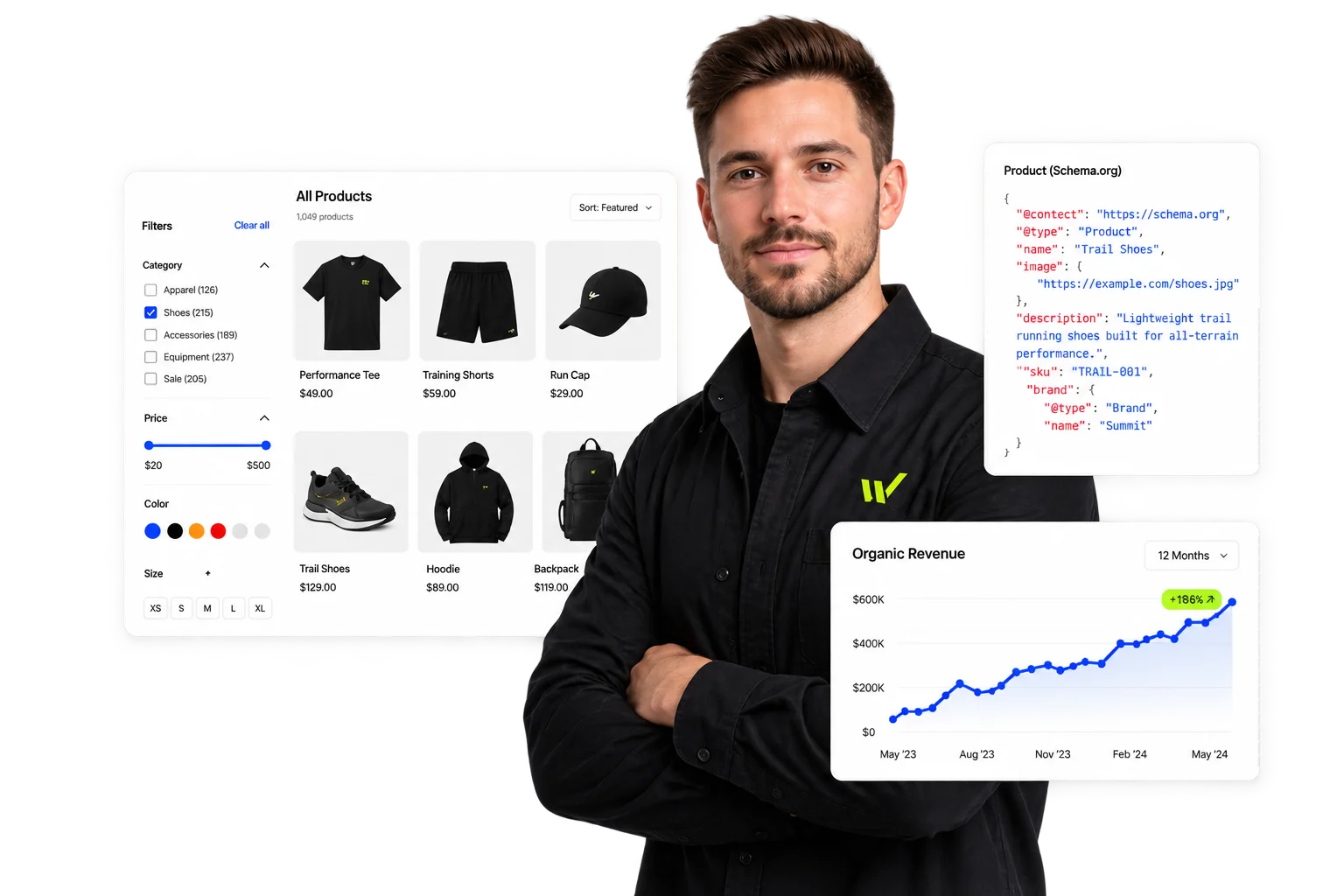
Every time a customer filters by size, color, price, brand, or material on your category pages, BigCommerce generates a unique URL for that combination. A store with 20 categories and 8 filter options can generate 40,000+ indexable parameter URLs from a few hundred real pages. BigCommerce canonicalizes filtered URLs back to the base category by default — but it doesn’t stop Google from crawling them. Your crawl budget gets spent on filter permutations instead of your actual revenue pages.
The fix isn’t “noindex everything” — it’s selective. Some filter combinations have real search demand (“red leather handbags” is a query people search; “handbags sorted by price ascending” is not). We identify which filter combinations earn indexation based on actual search demand and block the rest.
BigCommerce category pages ship with a product grid, a category name as an H1, and nothing else. Your category pages rank for buying queries — “pecan gift boxes,” “leather laptop bags,” “organic protein powder” — high-volume, high-intent searches where the buyer has decided to purchase and is choosing where. If your category page is just a grid, your competitor with editorial buying guidance above the grid outranks you.
We integrate concise editorial content into your category templates — positioned above the product grid without pushing products below the fold. Google gets something to rank. Your shoppers get context that increases add-to-cart rate.
Product options — size, color, material, weight — can create separate indexable URLs on BigCommerce. Without deliberate canonical strategy, your 5-lb bag of pecans competes with your 3-lb bag, your 1-lb bag, and the parent product page. Google indexes all of them. Your ranking authority splits four ways.
The decision isn’t automatic — it’s per-product. Some variants genuinely deserve separate indexation (a “red leather handbag” is a different search query from a “black leather handbag” and people search both). Others should consolidate to the parent (nobody searches “pecan halves 3-lb bag” as a separate query from “pecan halves”). We audit every variant URL against actual search demand and set canonicals accordingly.
Every BigCommerce product exists in three places simultaneously: the visible page (what the customer sees), the structured data in the HTML (what Google’s crawler reads), and the Google Merchant Center feed (what Google Shopping uses).
When the price on your page says $84.95, the Product/Offer schema says $79.95 (last sale price cached in the template), and the Merchant Center feed says $89.95 (pre-discount list price from the CSV export) — Google flags the mismatch. Your rich results disappear from search. Your Shopping listings get demoted. Your products stop appearing in AI shopping answers from ChatGPT Shopping and Google AI Overviews.
We audit all three layers and fix the inconsistencies that are silently costing you revenue every day you don’t know about them.
Stencil — BigCommerce’s Handlebars-based theme engine — renders server-side by default, which is good for SEO. But the theme makes decisions about your heading hierarchy, canonical tags, schema output, and image loading that most store owners have never inspected. Any customization — adding a section, changing a layout, installing an app — can introduce heading violations, schema conflicts, or lazy-loading that hides content from Google.
If you’re on Catalyst — BigCommerce’s newer Next.js headless framework — the stakes are higher. Catalyst can render server-side, but client-side rendering gaps are easy to introduce. AI crawlers don’t execute JavaScript at all, so anything rendered only client-side is invisible to ChatGPT, Perplexity, and Google’s AI Overviews.
ChatGPT Shopping, Google AI Overviews, Perplexity Shopping, Amazon Rufus — these AI engines are becoming a real product discovery channel in 2026. They cite product information from stores that have three things: clean structured data, server-rendered content, and consistent entity information.
BigCommerce has a structural advantage here: Stencil renders server-side, and the platform generates Product/Offer schema automatically. But “has the advantage” and “is using the advantage” are different things. Most BigCommerce stores have incomplete schema (missing Review, FAQ, Organization, BreadcrumbList), inconsistent entity data (the brand name rendered three different ways across the site), and no strategy for getting products cited in AI answers.
This is early-mover territory — most of your competitors haven’t started.
Send us your Drupal site and we’ll show you the Views crawl traps eating your crawl budget, the taxonomy pages cannibalizing your real landing pages, the Metatag tokens rendering blank descriptions, the config deployment risks that quietly reset your SEO, and the gaps keeping you out of AI Overviews. You get a prioritized findings roadmap with developer-ready tickets — yours to act on with or without us.